The Uniparty of the Maximal State
A Libertarian View of German Party Platforms
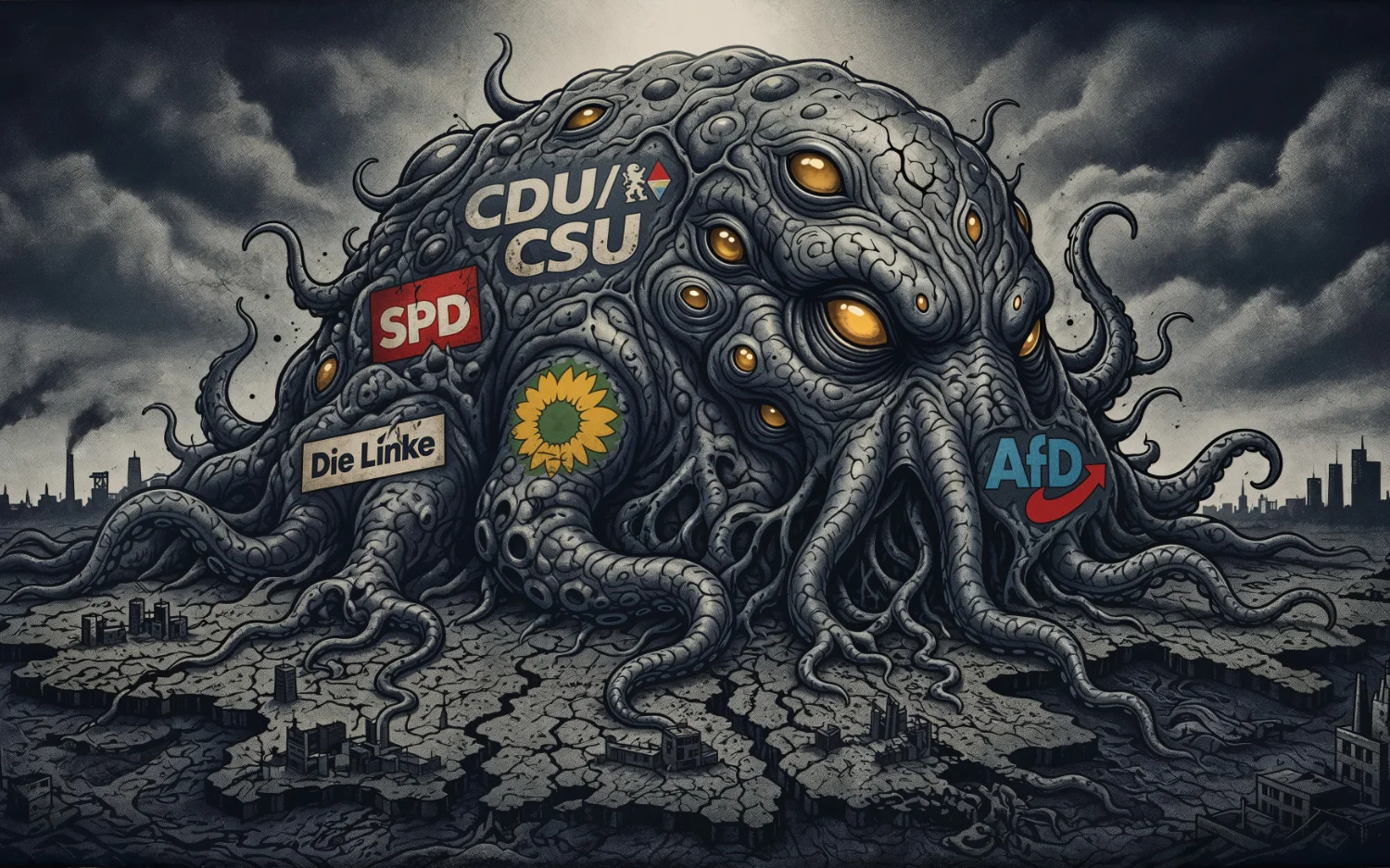
I have been watching German politics with growing contempt for most of my adult life. The colors on the ballot change—red, green, black, blue—but the country I live in keeps shrinking in freedom, getting more expensive, more bureaucratic, and more managed. After reading through the actual party programs of Die Linke, SPD, Die Grünen, CDU/CSU, and AfD side by side, the conclusion is no longer a suspicion. It is a fact. Germany does not have a multiparty democracy. It has a Uniparty of the Maximal State with five marketing departments.
What follows is a libertarian and anarcho-capitalist reading of those platforms. The parties differ on flavor—internationalist socialism, eco-authoritarianism, social-democratic management, Christian-conservative guided economy, and national-conservative welfare—and they fight bitterly about who gets the spoils. On the only axis that matters, freedom versus state power, they sit in the same corner. On the left-right line, they spread out a little. On the liberty axis, they cluster like a clenched fist.
The Illusion of Pluralism
The German voter is invited into a theater. Bright costumes, ritual denunciations, and talk shows full of staged outrage. Behind the curtain, everyone agrees on the important things: high taxation, an ever-growing Sozialstaat, central planning of energy and climate, bureaucratic supervision of education and culture, and the elevation of “Gemeinwohl,” “Solidarität,” and “Gerechtigkeit” over the individual. Property is a license. Freedom is a permission slip.
The disagreements are real but small. Who gets the subsidies? Which identities sit at the top of the moral hierarchy? Should the maximal state wear an EU flag or a German one? Nobody on stage is asking whether the state should be doing any of this in the first place. Murray Rothbard’s question—by what right does a monopoly on violence extract resources and dictate the terms of social organization? — is not even allowed in the building.
A first scan of the platforms makes the pattern obvious. Die Linke wants to overcome capitalism through “demokratischen Sozialismus,” public ownership, and “Wirtschaftsdemokratie.” The SPD promises “Mehr für Dich” through state-orchestrated growth, higher minimum wages, and expanded entitlements. Die Grünen frame their “sozial-ökologische Marktwirtschaft” with heavy state Leitplanken for climate, gender, and migration engineering. The CDU/CSU defends the Soziale Marktwirtschaft but insists on active intervention, energy steering, subsidy programs, and a “strong and just social state.” Even the AfD, with the most market-friendly rhetoric of the bunch, accepts the welfare state, family subsidies, infrastructure planning, and environmental regulation—only redirected toward national priorities.
The differences are who-benefits questions, not whether-the-state-should questions. None of them propose dismantling the coercive apparatus. Place them on a libertarian map of liberty versus power, and they all sit in the high-statism quadrant. They are variants of the same disease. Mussolini’s slogan—“everything within the state, nothing outside the state, nothing against the state”—fits all five better than any of them would care to admit.
Comparing the Platforms
Property: Conditional, Always
All five treat private property as a privilege granted by the collective, revocable when the collective decides it has a better use for your house, your savings, or your business.
Die Linke is the most honest about it. The program demands “den demokratischen Sozialismus” (democratic socialism) and “ein anderes Wirtschafts- und Gesellschaftssystem,” with public and employee ownership and socialization of key industries. Property serves “Gemeinwohl.” Translation: Property serves whoever currently controls the state.
Die Grünen wrap the same content in ecological language. “Die Wirtschaft dient den Menschen und dem Gemeinwohl.” Property “verpflichtet gesellschaftlich.” Markets are tolerated insofar as they obey the planetary and social goals defined by the party. This is corporatism with a green logo.
The SPD pushes state-driven “Made in Germany 2.0” through public investment and regulated “good work.” The CDU/CSU defends the Soziale Marktwirtschaft in speeches and runs industrial policy, energy intervention, and innovation subsidies in practice. The AfD talks about “freier Wettbewerb” and “Soziale Marktwirtschaft statt Planwirtschaft” while still accepting the welfare state and the regulatory framework around it.
Not one party defends absolute property rights. Not one party defends the homesteader, the saver, or the entrepreneur as someone whose property is his—not the collective’s on loan. This is cartelized statism, not pluralism.
The Sacred Sozialstaat
The German welfare state is the holy object that no major party will touch. Die Linke and the SPD want it bigger and more aggressive: more redistribution, higher minimum wages, stronger unions, and social security as a right. Die Grünen braid welfare together with ecological and gender justice. The CDU/CSU promises a “strong and just social state,” keeps the minimum wage, stabilizes pensions, and adjusts the incentive structure at the margins with “Fördern und Fordern.” The AfD accepts the minimum wage, reforms benefits toward “activating” measures, and adds family subsidies—but the Sozialstaat itself is left standing.
None of them ask the obvious question: why is welfare a state monopoly? Voluntary insurance, mutual aid societies, private charity, and family responsibility built the Western world long before bureaucrats discovered they could buy votes with stolen money. What the parties call “Solidarität” is forced transfer, with a generous administrative cut and a permanent client class baked in. It produces dependency, moral hazard, and intergenerational theft through taxation and debt. The opposite of self-responsibility.
Climate, Energy, Central Planning
On energy and climate, the consensus is even tighter. Grüne and Linke are the most radical. The SPD packages it as “Klimaschutz, den sich jeder leisten kann”—climate “protection everyone can afford,” said with a straight face while German industry runs from the highest electricity prices in Europe. The CDU/CSU criticizes “ideology” while keeping emissions trading, renewable expansion, and “technology-open” interventions, with a small opening toward nuclear. The AfD is the most skeptical of the climate panic and wants to end specific subsidies but still embraces environmental protection and state oversight of resources.
The shared premise—that the state must centrally plan energy, mobility, and land use—is precisely the premise Hayek demolished eighty years ago. Markets and individual adaptation are sidelined, central planners reign, and the result is what central planning always produces: blackouts in the making, deindustrialization, and a sticker price the next-generation pays.
Migration and Social Engineering
The mainstream parties converge on multiculturalism, anti-discrimination law, and state-managed integration, with heavy use of gender, diversity, and education policy as tools for remodeling the population. The AfD diverges sharply—strict asylum limits, Leitkultur, cultural preservation—but does it through the state, not against it. Everyone wants social engineering. They only disagree about the blueprint and the target population.
Democracy, Governance, Foreign Policy
All of them expand or maintain the bureaucratic apparatus, EU entanglement (with AfD nuance), and the “security” complex. Rhetoric about “democratization” thinly covers more control. Foreign policy oscillates between interventionism and “responsibility,” and the state’s power to make war and bind citizens to alliances is essentially never questioned.
Position them on the conventional left-right line, and they spread out from Die Linke/Grüne on the far left, through the SPD in the center-left, to the CDU/CSU in the center-right, to the AfD on the right. Position them on the liberty axis, and they clump together in the high-statism zone. The “extremism” warning lights only flash on the horizontal axis. The vertical one—the axis that actually matters—is kept conveniently invisible.
The Statist Core
Underneath the noise sits a shared metaphysics. The state is not a necessary evil to these parties, not a minimal night-watchman, not even a regrettable compromise. It is the central organizing force of society. The engine of progress. The guarantor of justice. The architect of the “good life.”
This is the actual Uniparty. From an anarcho-capitalist position, it is a betrayal of the individual on a civilizational scale. Where libertarians insist on self-ownership, voluntary cooperation, and the non-aggression principle, these parties treat coercion as the default tool for every human problem. The individual exists to serve the collective. Property is a social license. Freedom is what the state has not yet prohibited.
The documents say so themselves. Die Linke celebrates “demokratischen Sozialismus” and the need for a different “Wirtschafts- und Gesellschaftssystem.” Die Grünen write of state-defined Leitplanken on every meaningful question. The SPD’s “Mehr für Dich” is delivered through state investment, regulation, and orchestrated Aufschwung. The CDU/CSU defends the Soziale Marktwirtschaft while demanding active state leadership in energy, innovation, infrastructure, and welfare. The AfD, despite better rhetoric on bureaucracy, fully embraces a strong state that protects national identity, manages welfare, controls borders, and steers the economy toward German interests.
This is the total-state logic Hans-Hermann Hoppe described in Democracy: The God That Failed. Every sphere of life is presumed to lie within legitimate state intervention—work, housing, climate, energy, food, family, gender, education, speech, and money. The taxes are coercive. The regulations are violent interferences with voluntary contracts. The welfare transfers are aggression against the producer. The social engineering programs are an attempt to manufacture a “correct” citizen using state schools, state-funded media, and state-subsidized NGOs.
The left variants pursue an internationalist, egalitarian maximal state. The CDU/CSU prefers a more conservative, “responsible” version of the same thing. The AfD wants a nationalist variant that restricts the beneficiary class while keeping the machinery intact. All three are flavors of the same poison. This is why German policy barely changes when coalitions change. Grand coalition, Ampel, Jamaica, Kenia—the deck chairs move, the Titanic does not.
And the accusations of “fascism” hurled at the AfD are, in this light, almost a joke. The real total-state tendencies—the fusion of state and economic power, the suppression of dissent through cultural and regulatory means, the elevation of the collective over the individual—run through every party on the ballot. The accusers are the thing they claim to fight.
The AfD Smear as Boundary Enforcement
A core function of the Uniparty is the ritual demonization of the AfD as “extremist,” “right-wing populist,” or “fascist.” This is not analysis. It is boundary enforcement. It tells the voter where the acceptable spectrum ends, distracts from the statist consensus, and keeps the cartel safe from any meaningful challenge—even an incomplete one.
Die Linke, Grüne, and the SPD explicitly position themselves as the bulwark against “the right,” invoking historical antifascism while quietly building the most controlling state Germany has had since the wall fell. The CDU/CSU joins the protective barrier and treats cooperation with the AfD as unthinkable, despite enormous policy overlap on welfare, infrastructure, energy, and family policy.
A sober reading of the AfD’s own program makes the hypocrisy visible. The AfD accepts the Soziale Marktwirtschaft, the minimum wage, welfare reform (not abolition), state-managed infrastructure, environmental protection, and family subsidies. It wants a strong Bundeswehr, national sovereignty inside a “Europe of fatherlands,” and cultural preservation through state action. It criticizes bureaucracy and favors competition but never advocates the full privatization and voluntaryism an anarcho-capitalist demands. On most economic questions, the distance between AfD and CDU/CSU is a difference of degree and emphasis, not principle. More nationalism. Less globalism. Same state.
The intense focus on the AfD’s cultural and migration positions—strict asylum, Leitkultur, skepticism of Islam, and opposition to mass immigration—does the propaganda work. Meanwhile, the authoritarian habits of the mainstream parties stay invisible by polite agreement:
- Die Linke and Grüne openly push speech regulation, “antidiscrimination” enforcement, wealth taxes, and the transformation of society through state power.
- All parties support expansive surveillance, “hate speech” laws, and the use of state institutions—media, education, courts, regulators—to enforce ideological conformity.
- The welfare-warfare state, high taxation, EU supranationalism, and central economic planning are untouchable across the board.
The selective outrage reveals the priority. Preserve the size, the scope, and the legitimacy of the maximal state. Labeling the AfD “extremist” lets the rest pose as defenders of decency while they ratchet the Overton window further toward more state.
From a libertarian position, the AfD is the least bad of the bad options on several margins: more skepticism of bureaucratic overreach, stronger defense of national sovereignty and cultural continuity, and willingness to call the climate panic what it is. It is not a libertarian party. It wants to reform and redirect the maximal state along nationalist lines, not dismantle it. True liberty requires rejecting the entire framework—not Germanizing it.
The smear does double duty. It shields the left-center Uniparty from accountability for the messes they made—energy crisis, migration costs, fiscal strain, demographic decline—and it prevents the rise of any genuinely anti-statist alternative. In a free society none of this propaganda would matter. People would associate voluntarily, without coercive political monopolies. In Germany’s managed democracy, it is the cartel’s main weapon.
What a Real Alternative Looks Like
If all five parties presuppose the legitimacy of coercive state power, the answer is not a better manager. It is a different system. The libertarian alternative rests on two axioms: self-ownership and the non-aggression principle. Property emerges from homesteading and voluntary exchange. The state—a monopoly on violence—is illegitimate. Everything it currently monopolizes can and should be provided through competing private actors in a free market: security, law, infrastructure, welfare, education, money, and environmental stewardship.
The concrete pillars:
- Abolish coercive taxation and the welfare state. End taxation as institutionalized theft. Replace mandatory social security, pensions, unemployment benefits, and subsidies with voluntary insurance, mutual aid societies, private charity, and family responsibility. The sacred Umverteilung collapses. Dependency, moral hazard, and intergenerational plunder collapse with it.
- Full privatization and deregulation. Privatize education, healthcare, energy, transportation, and infrastructure. Property is absolute—“Eigentum verpflichtet” becomes “Eigentum ist heilig.” Environmental protection arises through tort law, private conservation, and homesteading, not from a bureaucratic Energiewende. Energy markets innovate freely across nuclear, fossil, geothermal, and renewables—without state favoritism or prohibition.
- Free migration with full property rights. Open borders, but zero welfare. Immigration is governed by property owners—employers, landlords, and communities—deciding whom to admit. This dissolves the statist contradictions on both sides: the left’s open borders + welfare, and the AfD’s closed borders + welfare chauvinism. Replace both with voluntary association.
- Polycentric law and defense. Replace the state monopoly on justice and security with competing private arbitration, insurance, and defense providers. Disputes are settled through reputation and contract, not politicized courts. National defense becomes voluntary mutual defense. No more “international responsibility” dragging German citizens into foreign wars.
- Sound money and free banking. End central banking and fiat money. Allow competing private currencies, including commodity-backed money and crypto. This kills the inflationary engine that funds the maximal state in the first place.
The parties promise security, justice, and prosperity through the maximal state. History and Austrian economics show the opposite. Coercive systems produce inefficiency, corruption, stagnation, and tyranny. A libertarian order produces something else:
- Explosive innovation and prosperity. Without taxation and regulatory drag, entrepreneurship flourishes. The German Mittelstand, unbound, would be unrecognizable in a decade. Poverty falls as markets—not bureaucrats—allocate resources. Nineteenth-century America, Hong Kong before the takeover, Germanys “Wirtschaftswunder”, modern special economic zones: the pattern is consistent.
- Genuine social harmony. Voluntary cooperation replaces forced solidarity. Charity becomes personal and effective, not laundered through ministries. Family, education, and identity are handled by individuals and communities, not imposed from Berlin.
- Peace. Without a powerful state to capture, the wars of “responsibility” stop. Trade and voluntary association build peace far better than NATO commitments or UN reform fantasies.
- Moral consistency. Only anarcho-capitalism is consistent with treating adults as sovereign agents instead of wards of the state. The parties’ vision—every sphere within the state—violates the non-aggression principle at its root.
Critics call this utopian. The genuine utopia is the conviction that the coercive institution that brought about energy poverty, demographic collapse, fiscal unsustainability, and cultural fragmentation will somehow resolve these issues once the “correct” party secures victory. The Uniparty offers different shades of chains. Libertarianism offers the key.
The transition is not a campaign. It is a culture. Intellectual honesty, parallel institutions, agorist counter-economics, private communities, crypto economies—built quietly while the cartel exhausts itself. It will not come through elections inside the cartel. It will come through ideas and through skin in the game.
Breaking the Illusion
Read the five programs in one sitting, and the conclusion is not arguable. Germany does not have a vibrant multiparty democracy. It has a Uniparty of the Maximal State—five factions quarreling over details while sharing the same foundational commitment to expansive state power, coercive redistribution, central economic and social planning, and the subordination of the individual to collective goals.
Their similarities outweigh their differences. All endorse a strong Sozialstaat funded by high taxation. All treat property as conditional on serving the “Gemeinwohl.” All demand state solutions to climate, energy, migration, education, and culture. They all reject unhampered markets, voluntary association, and the non-aggression principle in favor of political control. Left variants push internationalist egalitarianism and eco-authoritarianism. The CDU/CSU offers “responsible” guided economy. The AfD offers a nationalist-conservative flavor with less bureaucracy and stricter cultural lines. None of them propose dismantling the machine. On the left-right axis, they spread. On the liberty axis, they huddle.
The position is closer to Mussolini’s total state than to any defense of negative liberty. The expansion of government into every sphere of life—justified by “Solidarität,” “Gerechtigkeit,” “Nachhaltigkeit,” or “nationales Interesse”—erodes self-ownership and erodes the country with it. The ritual smearing of the AfD is propaganda whose purpose is to keep the illusion of choice intact and to police the acceptable boundaries of statism. Voters are sold different brands of the same poison.
An alternative exists outside the cartel: an anarcho-capitalist society built on self-ownership, absolute property, voluntary cooperation, and competing market provision of everything currently monopolized by the state. Abolish coercive taxation and the welfare state. Privatize education, healthcare, energy, and infrastructure. Replace state law with polycentric private arbitration. Restore sound money and free banking. The result would be transformative: explosive innovation, genuine moral responsibility, social harmony through voluntary association, and peace freed from state-driven conflicts.
The current path leads where it is already visibly leading—stagnation, dependency, cultural erosion, and ever more coercion. The libertarian path leads to emancipation, abundance, and human flourishing. The choice is not between parties. The choice is between the maximal state and liberty itself.
Real change will not come from voting inside the cartel. It will come from rejecting its premises. Through education, parallel voluntary institutions, agorist counter-economics, and the persistent spread of radical ideas of freedom, a different society becomes possible. Germans—heirs to a tradition of ingenuity, craft, and resilience—are uniquely positioned to lead that renaissance if they can see through the Uniparty illusion and choose individual liberty over the comforting chains of the maximal state.
Pick the key. Or keep wearing the chains and pretending the colors mean anything.
Policy Comparison
| Policy Area | Die Linke | Grüne | SPD | CDU/CSU | AfD | Libertarian / AnCap Alternative |
|---|---|---|---|---|---|---|
| Property Rights | Overcome capitalism; public/employee ownership | Property serves Gemeinwohl & ecology | State-guided “Made in Germany” | Soziale Marktwirtschaft + intervention | Free competition + welfare state | Absolute private property; no “social obligation” |
| Welfare/Sozialstaat | Expansive redistribution | Integrated into eco-justice | Strong entitlements & minimum wage | Strong & just social state | Reforming but preserving | Full privatization; voluntary charity & insurance |
| Economy | Democratic socialism | Sozial-ökologische Marktwirtschaft | State investment & growth | Active industrial policy | More market rhetoric | Laissez-faire; no central planning |
| Climate/Energy | Radical state transformation | Strongest state Leitplanken | Affordable Klimaschutz | Pragmatic intervention | Skeptical but regulatory | Market-driven; tort law & private conservation |
| Migration | Open for those in need | Multicultural integration | Modern immigration society | Controlled + integration | Strict asylum + Leitkultur | Open with full property rights; no welfare magnet |
| Overall Statism | Very High (internationalist) | Very High (eco-authoritarian) | High | High (conservative dirigiste) | Medium-High (nationalist) | None (voluntary society) |
References
- Partei Die Linke (2011): Programm der Partei Die Linke.
- Bündnis 90/Die Grünen (2026): Grundsatzprogramm.
- SPD (2025): Mehr für Dich. Besser für Deutschland. Regierungsprogramm.
- CDU/CSU: Politikwechsel für Deutschland. Wahlprogramm.
- Alternative für Deutschland (2016): Programm für Deutschland. Grundsatzprogramm.
- Rothbard, Murray N.: The Ethics of Liberty.
- Mises, Ludwig von: Human Action.
- Hoppe, Hans-Hermann: Democracy: The God That Failed.
- Hayek, Friedrich A.: The Road to Serfdom.